



"Theater at its best should feel like a real community effort.”
The creation of this article included the use of AI and was edited by human content creators. Read more on our AI policy here.
When Bad Bunny took the stage at Super Bowl LIX on Sunday, Feb. 8, he delivered far more than a performance — he created a cultural moment that captivated the nation. Early figures show it was the most-watched halftime performance of all time with more than 135 million viewers, per CBS News. For those fifteen electrifying minutes, the Grammy-winning reggaeton superstar transformed the biggest stage in American sports into a celebration of Puerto Rican heritage, complete with surprise guests, powerful symbolism, and yes, an actual wedding.
A Real Wedding at Halftime
Perhaps the most unexpected moment of the evening left millions of viewers wondering: was that couple really getting married during the Super Bowl halftime show?
The answer is yes. There was a couple featured in Bad Bunny’s Super Bowl LX halftime performance that many viewers didn’t know was real or not — but it’s confirmed they were legally married during halftime, league sources confirmed to ESPN. In a performance already packed with meaningful moments, this genuine celebration of love added an unexpectedly intimate touch to the massive spectacle.
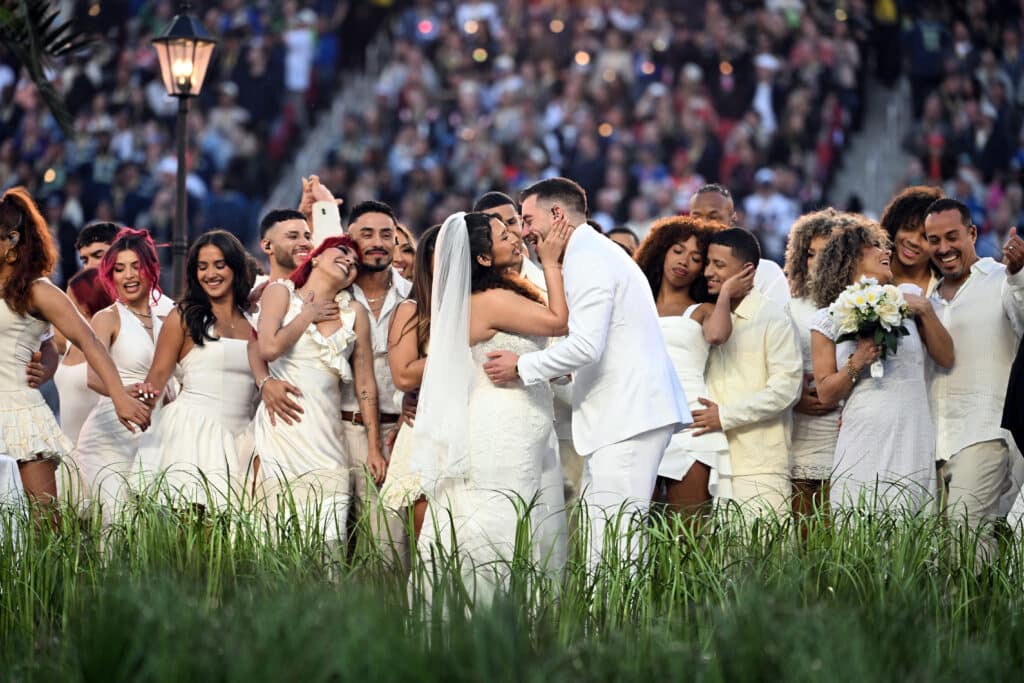
The wedding served as a reminder that even amid the pyrotechnics and choreography, Bad Bunny’s show was fundamentally about connection, community, and the moments that matter most in life.
Star-Studded Surprises at “La Casita”
The show featured surprise performances by Lady Gaga and Ricky Martin, bringing together artists who span generations and genres. These appearances weren’t just celebrity cameos — they represented the broad reach and influence of Latin music on American popular culture.
READ MORE: 10 Years of Nostalgia: Why the Internet Is Looking Back at 2016 With Rose-Colored Glasses
Beyond the musical guests, the performance included famous guests such as actors Pedro Pascal and Jessica Alba, rapper Cardi B and influencer Alix Earle, among others, at Bad Bunny’s “La Casita.”
A Visual Love Letter to Puerto Rico
Aside from suave showmanship and feel-good Latin rhythms, the Grammy-winning reggaeton superstar gave viewers an assortment of easter eggs alluding to his Latino heritage and Puerto Rico’s political history. For viewers unfamiliar with Puerto Rican culture, these details might have seemed like simple set dressing. But for those who understood their significance, each element carried deep meaning.
During the opening of Bad Bunny’s Super Bowl medley, several of the singer’s backup dancers — dressed as sugar cane field workers — wore pavas, brimmed straw hats traditionally made from leaves of the Puerto Rican hat palm. This imagery evoked the agricultural history of Puerto Rico, where sugar cane production was once central to the island’s economy. The pavas themselves are iconic symbols of Puerto Rican rural identity, representing the hardworking jíbaros (country people) who have long been celebrated in the island’s folklore and music.
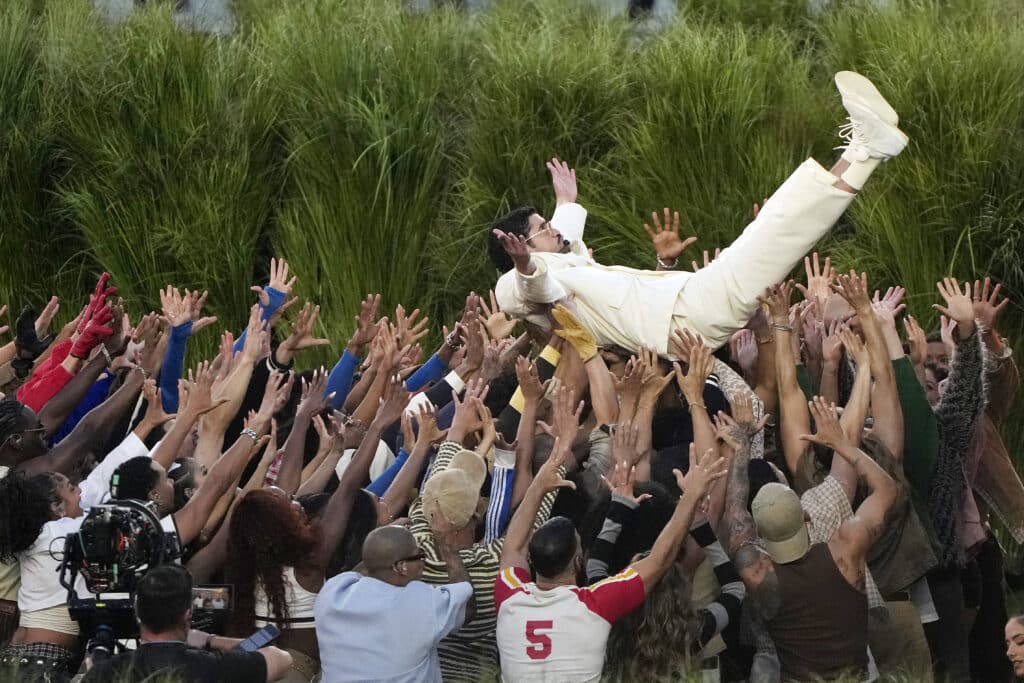
Bad Bunny also spotlights Puerto Rican cuisine throughout his performance, turning the Super Bowl stage into a showcase of island traditions.
While performing “Titi Me Preguntó,” the singer passed a group of dancers, cosplaying as customers, surrounding a coco frio cart. Coco frio, also known as fresh coconut water, is a refreshment commonly sold by street vendors on the island. For anyone who has walked the streets of San Juan or visited Puerto Rico’s beaches, the sight of a coco frio cart is instantly recognizable — a small but meaningful detail that transported viewers to the island.
Honoring Reggaeton’s Roots
Bad Bunny took a break from his hit-heavy discography to give a shout-out to the King of Reggaeton.
Following the singer’s mashup of “Yo Perreo Sola” and “Voy a Llevarte Pa’ PR,” he performed a snippet of Puerto Rican rapper Daddy Yankee’s iconic 2004 hit “Gasolina.”
“You’re listening to music from Puerto Rico,” Bad Bunny said in Spanish. “From the barrios and the projects.”
This moment was significant for multiple reasons. The reggaeton track, inducted into the Library of Congress’ National Recording Registry in 2023, is widely credited with popularizing the Latin urban genre in the 2000s. By acknowledging Daddy Yankee and the origins of reggaeton, Bad Bunny reminded the massive Super Bowl audience that this music — now dominating global charts — emerged from working-class Puerto Rican neighborhoods. It was a declaration of pride and a history lesson wrapped into one.
READ MORE: Nostalgia Used To Be a Serious Mental Health Disorder — But Now It’s Celebrated. Here’s Why
Concho the Frog: An Unlikely Symbol
Before Bad Bunny launched into the hip-hop banger “Monaco,” the camera panned to a screen projection featuring a Concho frog. For viewers unfamiliar with Bad Bunny’s recent work, this might have seemed like a random animated character.
Concho is an amphibious character that has become an unofficial mascot for the singer’s latest album, “Debí Tirar Más Fotos.” Concho, who is featured in the “Debí Tirar Más Fotos” short film and “Ketu Tecré” music video, serves as a representation of the Puerto Rican crested toad, an endangered species on the island.
The choice to feature an endangered species native to Puerto Rico speaks to the environmental consciousness woven throughout Bad Bunny’s recent work.
New York Roots and the Puerto Rican Diaspora
Bad Bunny may have been on the West Coast, but he brought a little of “Nuevayol” with him.
The singer, while performing the dembow-influenced opener of “Debí Tirar Más Fotos,” walked in front of a New York-inspired street set that included a storefront reading “La Marqueta.”
Now an open-air market in East Harlem, La Marqueta was originally an informal network of pushcart vendors and merchants that became an economic and social hub for the area’s Latino immigrant community from the 1930s to 1950s. The marketplace helped transform the New York enclave into Spanish Harlem.
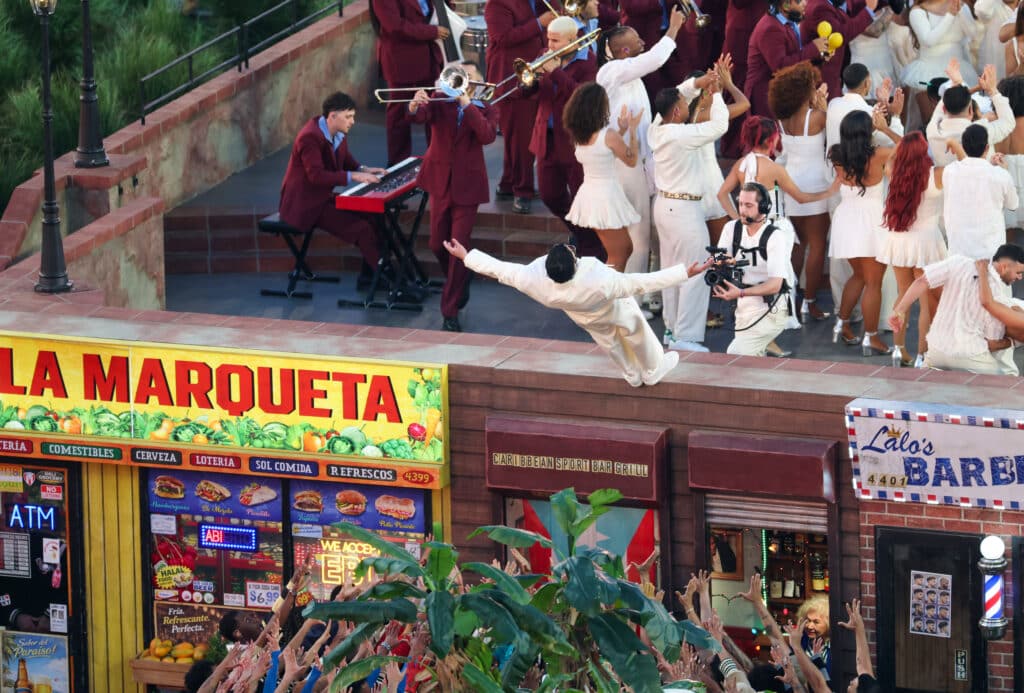
This tribute acknowledged the millions of Puerto Ricans who have made their homes in New York City and other mainland communities, creating vibrant cultural enclaves that have shaped American urban life. The diaspora experience is central to Puerto Rican identity, and Bad Bunny’s inclusion of La Marqueta honored that history.
A Powerful Political Statement
Towards the end of the show, the singer climbed an electrical pole, a reference to not only the power of Puerto Rico and its people but to power supply issues the island has struggled with. Many of his song lyrics criticize the ineffective response by the government in Puerto Rico to crises like the hurricanes that have pummeled the island and caused island-wide blackouts in recent years.
This wasn’t subtle symbolism — it was a direct acknowledgment of the infrastructure failures that have plagued Puerto Rico, particularly in the aftermath of devastating hurricanes. For Puerto Ricans who have endured extended blackouts and unreliable electrical service, seeing this struggle represented on the Super Bowl stage was deeply meaningful.
Bad Bunny’s political stance on issues affecting Puerto Rico has been firm since the start of his musical career. He has consistently used his platform to advocate for the island and its people, and the Super Bowl performance continued that tradition on the largest possible stage.
An Album Rooted in Heritage
The Puerto Rican superstar dropped Debí Tirar Más Fotos in January 2025, his sixth studio album. The 17-track project celebrates the culture and history of his native island. Which won the Grammy for Album of the Year.
The Super Bowl performance served as both a celebration of this Grammy-winning album and an introduction of its themes to the widest possible audience. For the 135 million viewers watching, it was an invitation to explore Puerto Rican culture more deeply.
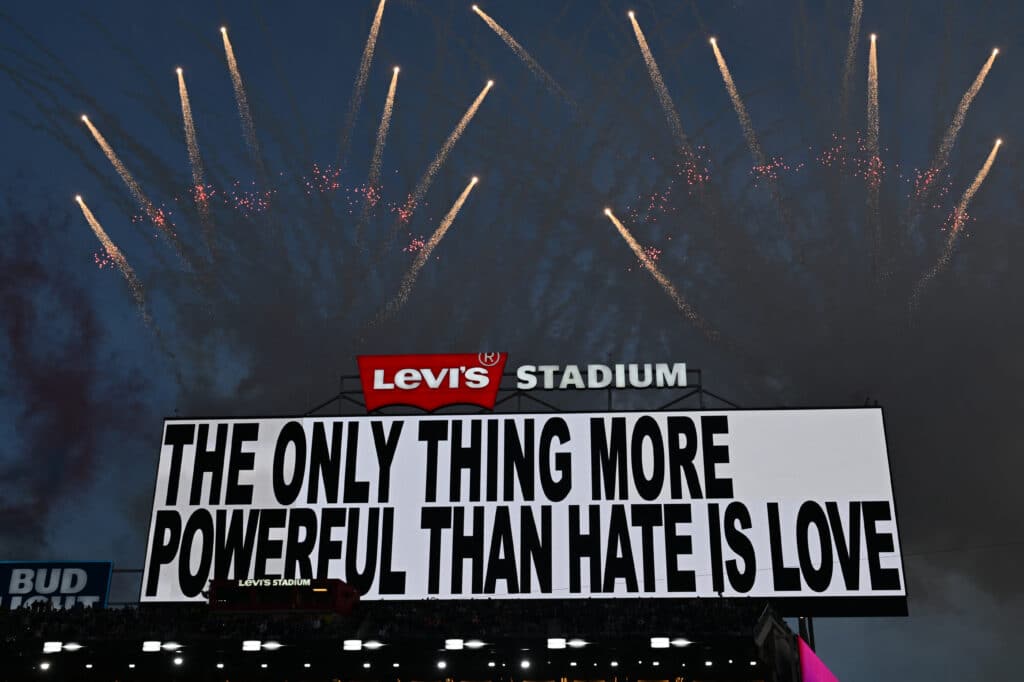
As he exited at the end of the show, trailed by U.S. and Puerto Rican flags and the flags of nations across the Americas, the message on a giant screen across the field read: “The only thing more powerful than hate is love.”