



The connection had some viewers feeling nostalgic — but others were left wondering why.
A team of scientists from Peru and France ventured into one of South America’s most inaccessible ecosystems and came back with a new species that had never been documented before.
A 2-3 centimeter frog with dark brown skin and striking golden irises, perched on the Amazon floor at roughly 1,350 meters above sea level.
But their discovery came with a catch. The habitat surrounding this new frog species has already lost 60% of its forest cover over the past 40 years.
What did the scientists find in the cloud forest?
The new frog species, formally named Oreobates shunkusacha, was discovered in a cloud forest in the San Martin region of Peru. The area had been virtually unexplored prior to the discovery because of how high, cold and remote the location is, according to Mongabay.
READ MORE: Ancient Elk Hide Fragments From Oregon May Be the World’s Oldest Clothing
The research team, accompanied by local guides, made two trips in 2022. The first trip ended short of the summit due to difficult terrain. On the second trip, they reached the high-elevation forests where they encountered the frog.
It took until 2024 to confirm it as a unique species.
The frog was formally described in a study recently published in the German journal Salamandra.
Researchers proposed “Shunku Sacha big-headed frog” as its common name. The species name pays tribute to the indigenous people of Peru: Shunku Sacha means “heart of the forest” in the native language of the Kichwa-Lamista people.
The new species could be endangered
The frog is currently known from only two locations in the department of San Martín: the Sacha Runa Conservation Concession, in the district of Sauce, and the Yaku Kawsanapa Concession, in the district of Chazuta.
That extreme geographic limitation is part of what makes the discovery both exciting and precarious.
Ernesto Castillo, a herpetologist at Ararankha and the Salamandra study’s lead author, explained the dynamic at work.
“Because these are isolated hills, they act like islands with unique ecosystems in which such species live,” Castillo said.
In other words, the frog’s entire known world sits on remote hilltops surrounded by lower-elevation land that functions like an ocean would for an island species. That isolation likely drove the evolution of a distinct species.
But it also means there’s no backup habitat if something goes wrong.
The frog’s habitat is under constant threat
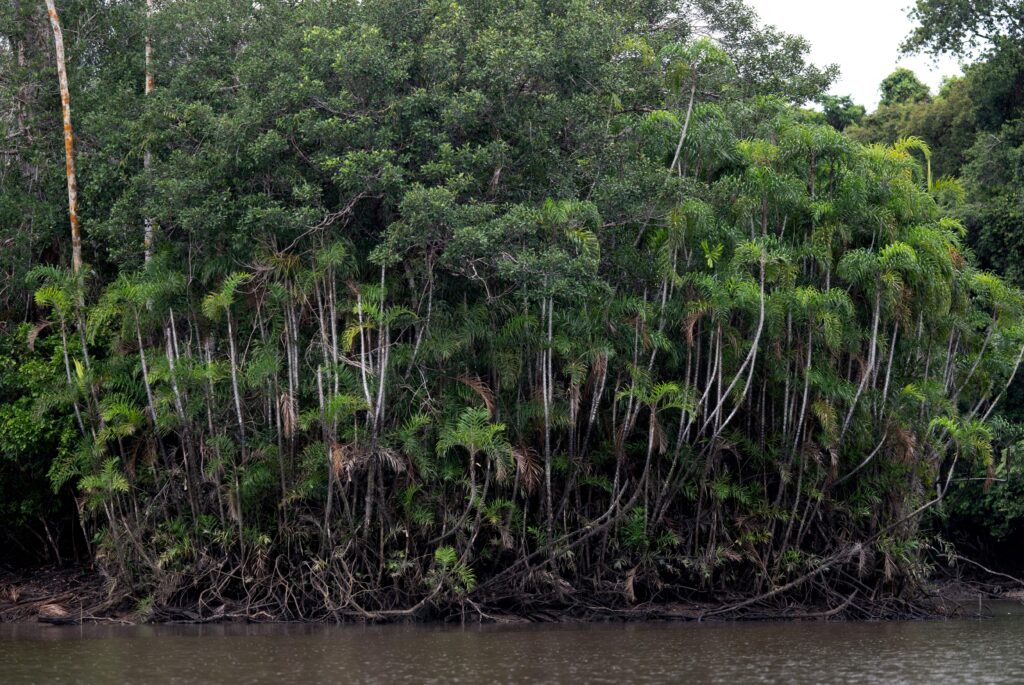
Due to threats to the frog’s habitat, scientists are warning that the frog should be classified as endangered.
According to Mongabay, the area comprising and surrounding the habitat of O. shunkusacha has lost 60% of its forest cover over the past 40 years. The main causes of this loss are small-scale coffee and cacao farming, livestock grazing, and illegal logging.
That’s a sobering timeline. The species was confirmed in 2024, meaning decades of habitat destruction were already well underway before anyone even knew this frog existed. Scientists are essentially trying to protect a species they just met from threats that have been compounding for four decades.
READ MORE: These baby girl names inspired by animals are wild, charming and impossible to forget
Kenneth Mori Ríos, president of the Sacha Runa Ecological Association, described the situation and the aspiration in direct terms.
“The greatest challenge is ensuring the protection of the biocorridor,” Mori Ríos said, per Mongabay. “It’s a dream we have: to see this entire area free from environmental crimes so that the species being discovered can endure over time. We hope that, with the support of our authorities and partners, we can make this dream a reality.”
He’s not just talking about one frog. He’s acknowledging that this cloud forest likely holds more undocumented life, and that the window for finding and protecting it is narrowing.
What to watch for as this species fights for survival
The frog discovery sits at the intersection of two forces running on very different clocks.
Biodiversity exploration in remote regions is accelerating as researchers push into previously inaccessible terrain. At the same time, habitat loss from agriculture and logging continues to eat away at the very ecosystems those researchers are racing to document.
The naming of O. shunkusacha — rooted in the Kichwa-Lamista language and tied directly to local conservation concessions — reflects a model where indigenous communities, local conservation groups, and international scientists collaborate on both discovery and protection.
The two sites where the frog was found are both conservation concessions, not national parks or government reserves, which means local stewardship is the front line.
For anyone tracking how conservation intersects with biodiversity science in real time, this is one to follow.
A species that went from unknown to potentially endangered in the span of two years tells you something about the pace of both discovery and loss in ecosystems that haven’t been fully mapped.
ALSO ON MOD MOMS CLUB: Country music star Tayler Holder shares video of him rushing into burning barn to save his animals
The frog itself is small — 2-3 centimeters, small enough to sit on a coin. The questions it raises about what else lives in Peru’s unexplored cloud forests, and how much time remains to find out, are considerably larger.