


That camping trip your family still talks about? Science says it’s worth more than any toy under the tree.
There’s a new Ebenezer Scrooge on the loose — and its name is Google.
As technology and artificial intelligence find their way into the hands (and ears) of young kids and teens, parents everywhere are struggling to accept the harsh reality that it creates come Christmas time.
Some parents describe it as “betrayal.” Others are “annoyed” and even “offended” at Google’s honesty.
For Jeanice Perez, a 37-year-old single mom from Las Vegas, that harsh reality was met in full force when her third-grade daughter Jordyn came home from school yelling, “We need to talk!”
READ MORE: Brenda Song Says Maintaining Holiday Magic Is “Getting Tricky”
Unfortunately for Perez, her daughter asked Google the one question parents hope their kids never ask Google.
“Is Santa Claus real?”
Google, which provides an AI overview when answering basic questions like the one above, gave Perez’s daughter an honest reply — and Perez didn’t know how to deal with the consequences.
“I’d spent years committing to the bit,” she told the “New York Post” in an interview, published Nov. 20.
“Perfecting my ‘Santa’ handwriting, making sure the reindeer had their carrots, nibbling the cookies just right, making sure not to let her find the wrapping paper ‘Santa’ used for her presents,” she added.
@dereklipp_ When alexa ruined christmas
♬ original sound - Derek Lipp
Perez is one of the many parents these days that feel “betrayed by Google.”
And it’s even ruining Christmas for kids who don’t directly ask if Santa Claus is real or not.
One mom told the “New York Post” that her son asked Google what Santa’s budget was when it comes to Christmas gifts — but Google was, yet again, a little too honest.
“There is no set amount Santa spends per child, as he is a fictional character,” Google responded.
“I was shocked, laughing in disbelief, telling him, ‘No, no. Google doesn’t always tell the truth. I still believe in Santa. Don’t listen to Google,’” the mother told the outlet.
Is Santa real? Here’s what your favorite chatbot says
According to Semrush, “is santa real” is typed into a search engine more than one million times per year.
Other popular searches include “is santa claus real” and “is santa for real.”
Considering most parents know the answer to that question, it’s safe to assume that a lot of those searches are coming at the hands of the younger generation.
And parents won’t be too pleased to find out what those search engines have to say.
READ MORE: You won’t believe what these iconic Christmas movie stars are doing now that they’re grown up
For example, Google’s AI overview reads, “No, the mythical figure of Santa Claus isn't a real person, but the legend is based on Saint Nicholas, a 4th-century bishop known for his generosity.”
“The modern character of Santa Claus is a fictional and cultural icon that evolved over centuries, with a rich history and symbolic meaning centered on the spirit of giving,” Google continues.
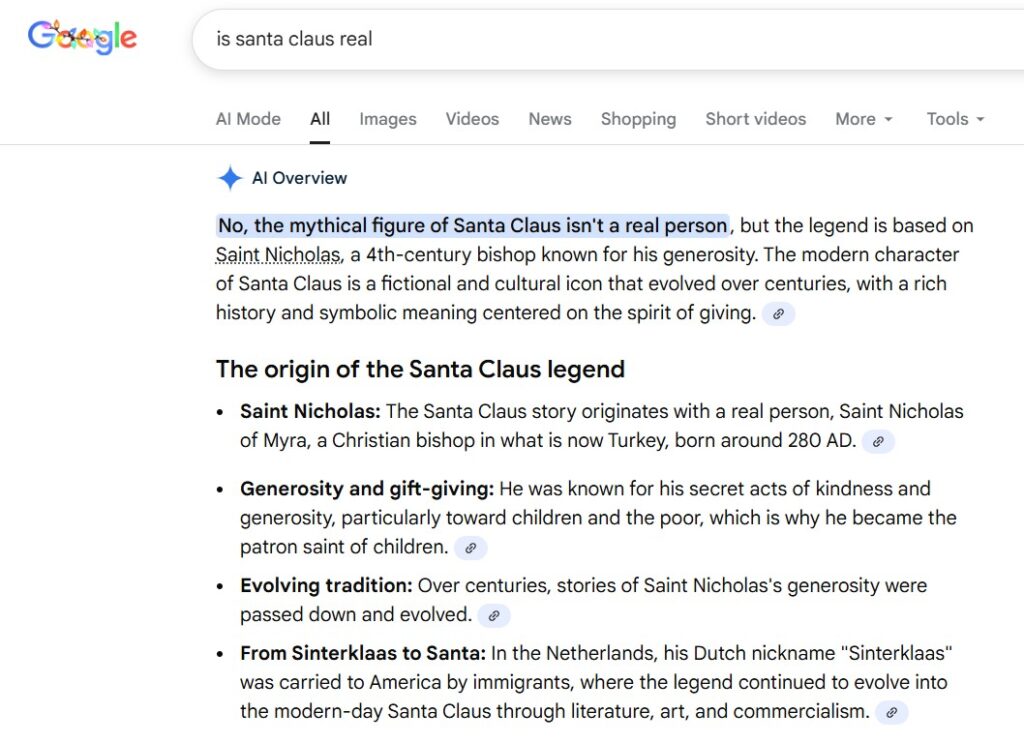
ChatGPT takes a more careful, yet still honest approach.
“If you’re asking whether there is a magical man who literally flies around the world in one night: Most people see Santa as a story, a tradition, and a symbol of generosity rather than a physical person doing that.”
Even Grok, a chatbot developed by xAI, Elon Musk's AI company, acts more like a Grinch come Christmas time.
“No, Santa Claus as a literal magical guy who flies around the world in one night with flying reindeer delivering presents to billions of kids is not real. That's the fun myth.”
According to the “New York Post,” Siri is one of the few chatbots that prefers to not get involved.
“That’s something I’m not allowed to disclaus. I mean … disclose,” Siri replied, per The Post.
AI experts share their Christmas advice for modern parents
The battle between parents and AI is real — and will only get more intense in the coming years.
According to a 2025 census by Common Sense Media, 40% of children today have a tablet by the age of two and roughly 25% of children have their own smartphone by the age of eight.
With the rise of virtual assistants like Alexa and Siri, a child’s curiosity can be ruined in the blink of an eye.
According to Jeremy Gutsche, an AI expert and founder of Trend Hunter, parents will lose this battle with AI more often than not, but that doesn’t mean it’s the end of childhood wonder.
“It is an unstoppable force, which may push us to rethink how we teach our children about Christmas and whether or not Santa is a real character,” Gutsche told The Post.
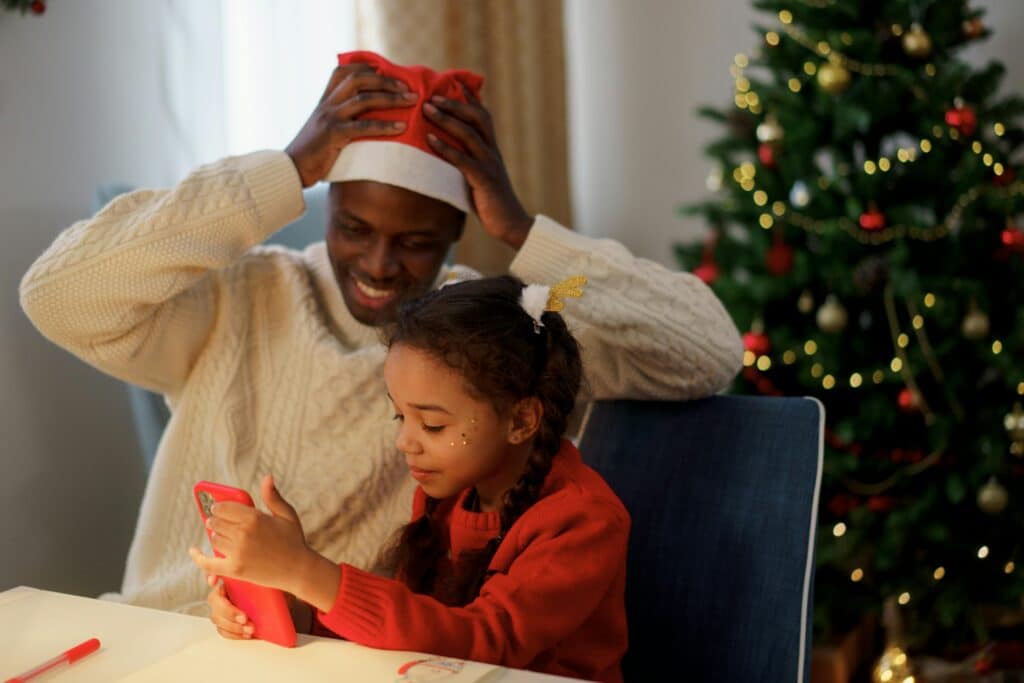
And while kid-friendly responses could be a solution, parents should prepare for anything their kid might learn through AI.
“We need to retrain our thinking in order to quickly adapt to changes in this new AI world, versus hoping there will be regulations, which probably won’t happen,” Gutsche added.
But there is hope — at least for parents like Bowron who managed to preserve her son’s innocence.
ALSO ON MOD MOMS CLUB: Mark Consuelos shared his Christmas gift idea for his kids — then immediately regretted it
According to The Post, Bowron was “annoyed” at Google’s response and her son even “gave it the middle finger,” but he ultimately believed his mom when she told him that Santa was, in fact, real.